
A new study has investigated hundreds of videos and images taken by the public, tourism operators and scientists to better understand a rarely studied behaviour among whales and dolphins – do they actually “play” together, or is it more of a one-sided relationship?
Led by Griffith University’s Whales & Climate Program lead, Dr Olaf Meynecke, the study analysed instances of baleen whale and dolphin interactions involving 19 species in 199 separate and unrelated interactions, documented by photographs and videos from 17 locations around the world.
Published in Discover Animals, Dr Meynecke said the findings demonstrated a quarter of these interactions can be defined as a mutual interaction.
“And in particular for humpback whales, we found that for one-third of the events the behavioural responses towards the dolphins appear positive. The humpback whales were rolling from side to side, undertaking belly presentation and other behaviours that are associated with courtship or friendly socialising.” Dr Olaf Meynecke
“Whales also strategically moved slowly in the direction of the dolphins with their head and rostrum.
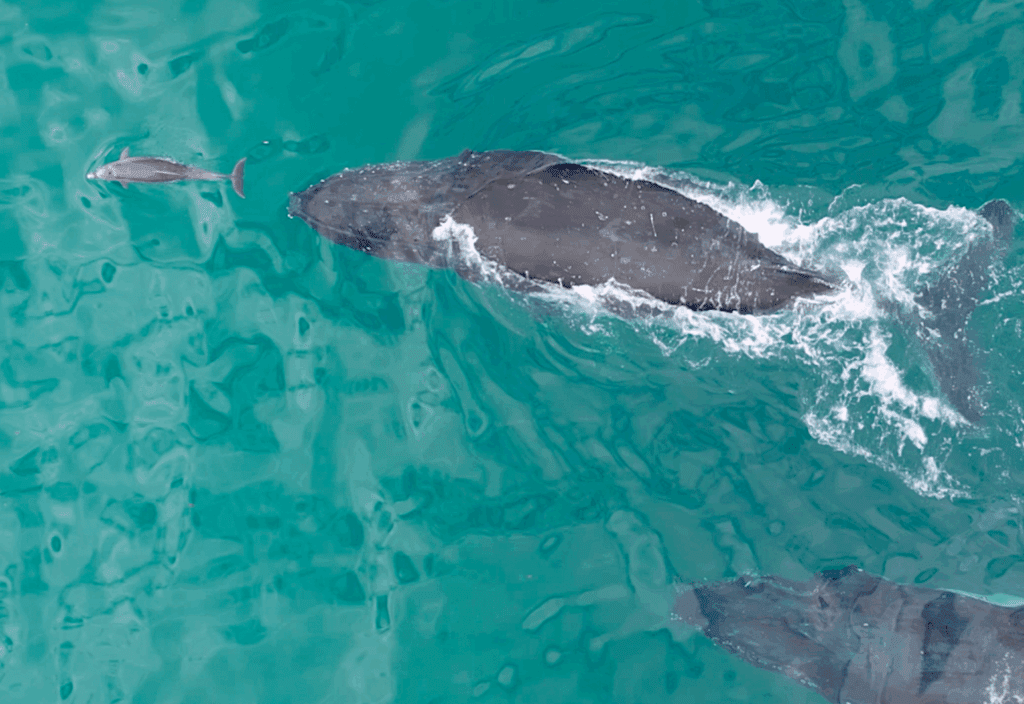
“The vast majority of the observed interactions did not show avoidance behaviour.
“We were in particular interested to document the whales’ reactions and responses toward the dolphins’ as commonly dolphins are described to harass and annoy the whales.”
Co-author and Masters graduate Olivia Crawley said: “When you’re out on the water, you often see whales and dolphins interacting and as a scientist, you can’t help but wonder why.
“Having the opportunity to document these observations and observe some of the behavioural patterns like bow riding by dolphins and close touches was intriguing.
“I hope that this study can serve as a foundation for future studies.”
Within each interaction, the authors noted the species of the whale and dolphin, the date and time of the interaction, the location, the number of animals involved, the age class, and the relative position of the dolphins in relation to the whale´s main body parts (rostrum or the ‘beak’, flank, and fluke or tail).
The most common whale-dolphin interaction involved dolphins swimming near the whale’s rostrum, akin to bow riding, which could indicate an energy-efficient mode of locomotion and a form of one-sided play by dolphins.
In total the documented interactions included 425 baleen whales from six different species, with humpback whales dominating (68%) then grey whales (16%) and fin whales (7%).
An estimated 1570 dolphins were observed, with bottlenose dolphins (51%), common dolphin (17%) and pacific wide-sided dolphins (15%) dominating.
Adults formed the largest number of documented interactions, however a whale calf was present in 44 events, and dolphin calf in 53 events. Both whale and dolphin calves were present in 21 occasions.
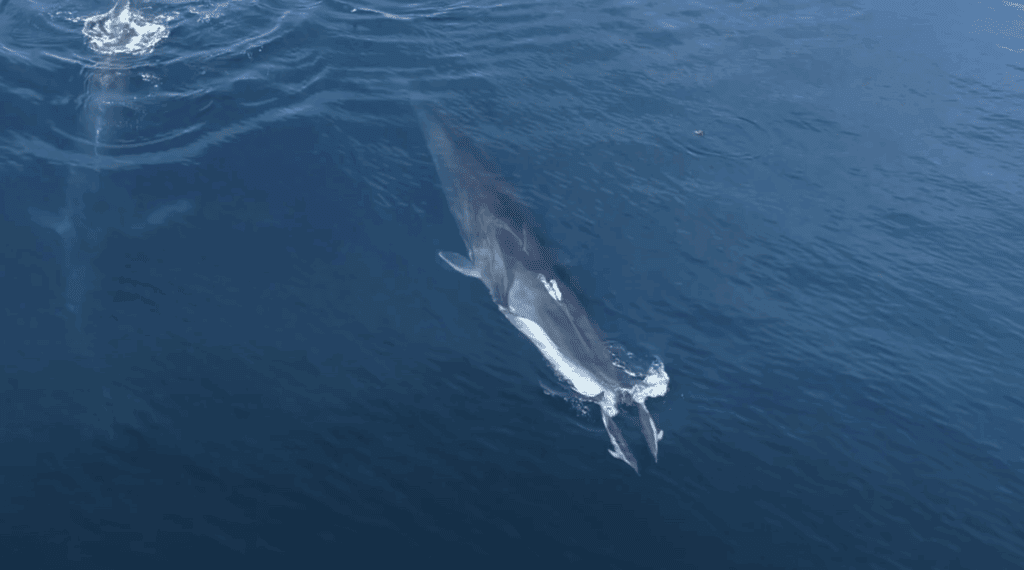
The whale species responded differently to the dolphin behaviour; humpback whales moved their pectoral fin toward the dolphins (172 counts) while grey whales were often rolling (56 counts) and southern right whales displayed pectoral slaps (5 counts out of 10 separate events).
Physical percussive behaviours that could indicate aggressive responses toward dolphins such as tail slaps (18 counts) or head slaps (none) were least observed for humpback whales.
Two videos from suction camera tags on humpback whales also showed bottlenose dolphins following humpback whales not only on the surface but also to the ocean floor where they continued engaging in close approaches including possible touching and social play.
“While social play is cooperative and reciprocal, there is also one-sided play or interaction, with only one participant perceiving the interaction as playful, as seen in cases of teasing or harassment by dolphins during feeding events,” Dr Meynecke said.
“Behavioural studies of marine mammals such as these provide insight into their complex social structures, play a crucial role in enhancing our understanding of marine ecosystems and the interactions among marine species.”
The study ‘Assessing social behaviour between baleen whales (Mysticeti) and dolphins (Delphinidae)’ has been published in Discover Animals.

