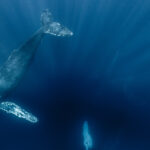
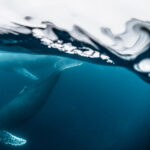
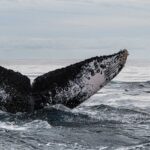
Australia’s East Coast will soon see the arrival of thousands of humpback whales on their northward migration to warmer waters.

But an Australian-based researcher who was privy to an exclusive view of humpback whales off the Baja California Sur waters of La Paz, Mexico, said there are global signs of the upcoming migration season’s highs and lows.
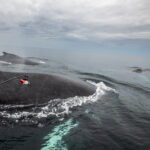
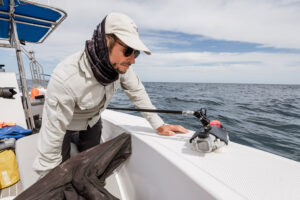
Dr Olaf Meynecke, Lead Researcher and Manager of the Whales and Climate Research Program at Griffith University, was part of a research expedition earlier this year in which he was tracking humpback whales using suction tags collecting data on swim speed, dive profiles, direction, sound and vision in the deep waters off the Gulf of Mexico that plunge down to 3000m depths.
Throughout the expedition, Dr Meynecke witnessed behaviours and encounters he had not yet seen off Australia’s East Coast in such intensity.
“We were amongst highly competitive males aiming for the best position next to a female. About 20 humpback whales were involved in this intensive heat run. The sound of the exhausted whales breathing out and their fast swim speeds felt like trains rushing by our boat,” Dr Meynecke said.

“These whales were tagged with suction cup tags to study their complex underwater behaviour. Much to our surprise, we also saw short, deep dives, down to almost 200m depth, followed by fast swim speeds and underwater battles among these individuals.”
During the whale migration in Australia, humpback whales generally don’t have the option to make deep dives as the continental shelf extends widely from the coast.
Studying heat runs and competitive groups allows Dr Meynecke to continue to learn more about the complex dynamics in these groups. There are various positions male humpbacks whales in a group adopt such as primary escort, challengers and observers. Males work together against each other and vary their techniques to deter competitors.
But not all encounters were as joyful and dynamic. During the 10-day expedition, Dr Meynecke and the team encountered a young and sick humpback and another entangled in fishing gear, underlining the “clear signs of increasing impacts on this species”.
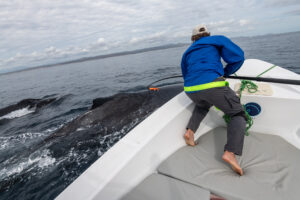
“The scarring on whales like this from previous entanglements tells a story about the scale of the issue globally, with many whales having to battle for their survival when trapped in nets and lines.”
“There are a lot of human-driven impacts on global whale populations. One recent study from the Northern Hemisphere confirmed the deadly toll climate change can take; food shortages have led to a decline in Hawaiian humpback whale populations – how much pressure can these populations withstand before we start seeing declines and related cascade impacts on ecosystems?”
Meanwhile, the first humpback whales on the 2024 migration season have been sighted on the east coast of Australia – but, with the recent experience fresh in his mind, what does Dr Meynecke expect to see in the coming months?
“We will see an earlier than average start of the main migration from mid-May onwards and also see again a number of entangled whales in fishing gear move up the coast. Sadly, they are just the tip of the iceberg with many of them remaining unseen and unable to track.”

For Dr Meynecke, there is much still to study and document regarding humpback whale behaviour and the issues impacting him. Research that will also benefit other whale species by developing new methods.
However, what holds Dr Meynecke and the Whales and Climate Research Program team back from performing consistent and comprehensive studies around the world is significant investment into this important research area.
“For our Whales and Climate Research Program, my aim is to advance our current outcomes to a global initiative that safeguards whales into the future encompassing the Northern Hemisphere.
“We are now a UN Ocean Decade endorsed research group, with our Phase 2 research program seeing an expansion to South America until our funding ceases.
“The generous philanthropic funding WCP has received to date has fuelled and empowered our research teams in South Africa and South America to undertake vital studies on humpback whales and climate impacts.
“But for this work and our findings to truly make an impact on whale populations globally, we need to expand to the Northern Hemisphere.
“My vision and dream is to bring this very successful work we have been doing for whales to the global level, creating a whale data portal/tool that is accessible to the public, but most importantly policy makers.
“We need to be ambitious about our work as we are facing never experienced challenges with climate change in regard to whale protection.”